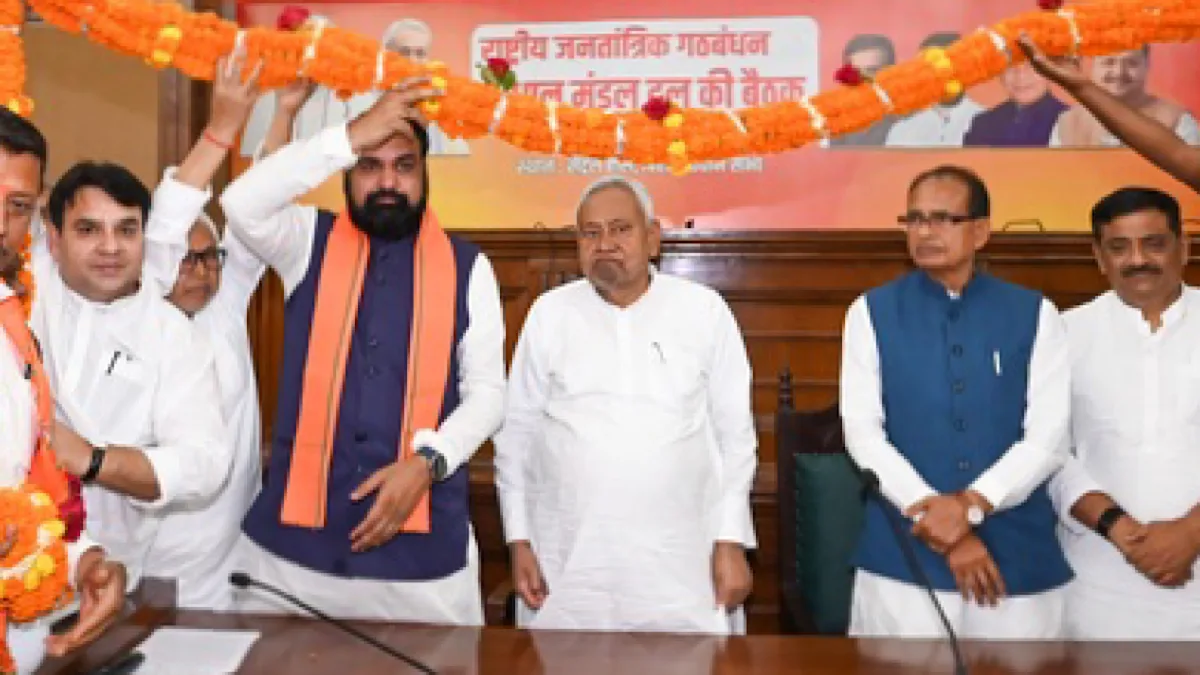
BJP’s Chief Minister-designate Samrat Choudhary has several strengths — his caste background, his administrative abilities, his age, and his closeness to key NDA ally Janata Dal (United)—that together worked in his favour as the party looked for a replacement for Nitish Kumar. Observers say his elevation to the top post was effectively decided the day he was handed the Home Ministry—a prestigious and crucial portfolio—in the BJP–JD(U) government led by Kumar after the 2024 elections.
Incidentally, Choudhary is not from the conventional nursery of prospective BJP leaders—the Rashtriya Swayamsevak Sangh. His father was a prominent Congress leader, and he himself has been associated with different political parties in the state, beginning with the Rashtriya Janata Dal (RJD) and then the JD(U), before eventually settling in the BJP where he rose to his current position. In those terms his appointment marks a historic milestone in many ways, including as the first BJP leader to hold the Chief Minister’s post in Bihar.
Advertisement
Sources say one of Choudhary’s key strengths is his administrative experience. He has served as Deputy Chief Minister and handled the Home Affairs portfolio, a portfolio generally retained by chief ministers. But apart from his administrative capabilities, his caste identity makes him an important asset in a state where social equations are important in driving election outcomes. A prominent leader from the Kushwaha (Koeri) community, his appointment is seen as part of the BJP’s broader strategy to consolidate support among OBCs and EBCs.
Bihar leaders say that one of Nitish Kumar’s biggest political achievements was the social coalition he built with the BJP—bringing together upper castes, Extremely Backward Classes (EBCs), and his own Kurmi community, a formidable social bloc that opponents like the RJD struggled to counter. The “Luv-Kush” combination—the political consolidation of Kurmi and Koeri (Kushwaha) communities—along with OBCs and upper castes made a durable and powerful alliance with rivals of NDA found difficult to penetrate.
In fact, they add that the RJD would have preferred the BJP to appoint a Chief Minister from an upper caste. “Earlier, the RJD had strong control over EBCsbut is now largely dependent on the Muslim-Yadav factor, which is just not sufficient to bring power. As a Kushwaha (Koeri), Choudhary fits into the broader ‘Luv-Kush’ social grouping, making him crucial for retaining EBC support,” they say.
Now the question, why Choudhary and not someone else from the community or EBC groups? According to observers, Bihar, unlike states such as Rajasthan or Madhya Pradesh, cannot afford to experiment with a complete novice in the Chief Minister’s role. The state requires someone with administrative and bureaucratic experience and among younger BJP leaders, Choudhary stood out, making him the most obvious choice in a party otherwise known to spring surprises, as in Madhya Pradesh, Odisha, and Rajasthan.
The third, but an equally important factor, was his relationship with the JD(U). Sources say Choudhary has a strong working relationship with the ND ally, which supported and backed him completely. The bureaucratic establishment also took note of this alignment after Nitish Kumar’s move to the Rajya Sabha.
At 57, Choudhary is regarded as one of the BJP’s strongest organisational figures in the state, playing a central role in the NDA government, and representing the BJP alongside Nitish Kumar at official and political events.
Interestingly, before the BJP and JD(U) renewed their alliance in 2024, Choudhary was one of Nitish Kumar’s sharpest critics. In 2022, he publicly declared he would not remove his saffron turban until Kumar was removed from power. The pledge ended rather dramatically when after the NDA alliance returned to office, he visited Ayodhya, offered the turban to Lord Rama and took a ritual dip in the Saryu.